

How to choose a punching bag: the complete guide
of reading
Quick answer: four essential criteria — the weight (about 50% of your body weight), the length (130 cm for boxing, 150-180 cm for kicking), the material (PU to start, leather for experienced users) and the mounting type (hanging, free standing or frame).
You want to train at home but you are not sure which bag to choose. Between weight, length, material and mounting, there are a lot of parameters. This complete guide gives you everything you need to get it right first time.
What weight should your punching bag be?
This is the most important rule: your bag should weigh about 50% of your body weight. A bag that is too light bounces too much and does not build power. A bag that is too heavy tires the shoulders and wrists for nothing.
What length for your discipline?
| Discipline | Recommended length | Why |
|---|---|---|
| Cardio boxing / starting out | 80-100 cm / 31-39 in | Compact format, easy to install |
| Boxing | 100-130 cm / 39-51 in | Hands only, chest height |
| Kickboxing / Muay Thai ★ | 150-180 cm / 59-71 in | Low kicks and knees reach the bottom of the bag |
| Grappling / MMA | 160-180 cm / 63-71 in | Covers the whole body area to work |
The 5 types of punching bag
Hanging, free standing or on a frame?
| Type | Fixing | Feel | Noise | Ideal for |
|---|---|---|---|---|
| Ceiling hung | Required | ★★★★★ | High | House, garage, gym |
| Frame ★ | None | ★★★★ | Moderate | Renters, garden |
| Free standing | None | ★★★ | Low | Flats |
Which material should you choose?
- 🟡Synthetic PU: for starting out. Accessible price, easy care, resistant to damp. Lifespan 3-5 years with regular use.
- 🟤Genuine leather: for experienced users. Premium feel on impact, develops a patina over time. Lifespan 8-15 years. Needs leather cream every 2-3 months.
- 🔵Canvas: very resistant to abrasion. Often used for bags with an integrated water core. A rougher surface than PU.
Filling: as important as the outside
The filling determines the feel on impact and the protection of your hands. A poorly filled bag can cause injury even in good gloves.
- Compressed recycled textile (standard): density varies with compression. If the bag is too hard, it needs breaking in by hitting it progressively over the first few weeks.
- Sand and textile: heavier and harder. For advanced practitioners only.
- Water: the closest feel to a real impact. Very popular in MMA. Some bags let you set the firmness through the water level.
- High-density foam: softer, ideal for protecting the wrists and for beginners.
Tip: if your new bag feels too hard on delivery, hit it at 60% for the first two weeks. The filling settles and reaches its optimal density progressively.
The mistakes beginners make
- ×Choosing a bag that is too light. A 15 kg bag for a 75 kg adult swings too much, distorts the feel and does not build power.
- ×Training without gloves or wraps. Hitting bare-handed, or in simple fitness gloves, causes injury to the wrists and the metacarpals.
- ×Fixing the bag to a plasterboard wall. A stud wall does not take dynamic loads. Concrete ceiling or timber beam only.
- ×Always hitting the same spot. Concentrating impact on one point hardens the filling locally and creates hard zones that injure the hands.
Looking after your punching bag
- After every session: wipe the surface with a damp cloth. On a PU bag, avoid stripping products.
- Every 2-3 months: check the stitching, chains and carabiners. Tighten if needed.
- Leather bag: apply a nourishing leather cream every 2-3 months to prevent cracking.
- Storage: do not leave your bag in cold or damp conditions. PU stiffens below 5 °C (41 °F) and eventually cracks.
Quick decision table
| Profile | Weight | Length | Type |
|---|---|---|---|
| Beginner, cardio boxing | 20-30 kg / 44-66 lb | 100-130 cm | Free standing |
| Boxing, recreational | 30-40 kg / 66-88 lb | 120-130 cm | Hanging or frame |
| Kickboxing, Muay Thai ★ | 40-60 kg / 88-132 lb | 150-180 cm | Hanging |
| Competition, intensive | 50-80 kg / 110-176 lb | 160-180 cm | Hanging, leather |
Esprit Boxe punching bags
Frequently asked questions
Can you use a punching bag without gloves?
No. Hitting bare-handed causes injury to the metacarpals and the wrists, even on a soft bag. Always wear wraps and bag gloves. Fitness gloves do not protect enough for intensive sessions.
Which bag should I choose for a flat?
A free standing bag with a water-weighted base. No fixing, and no impact passed into the structure. To reduce vibration through the floor, put an anti-vibration mat under the base.
How long does a punching bag last?
A quality PU bag lasts 3 to 5 years with three sessions a week and correct care. In genuine leather, well maintained: 8 to 15 years. The first signs of wear are cracking on the surface and the filling settling.
What is the difference between a punching bag and a sand bag?
A sand bag, filled with sand, is very heavy and very hard. It is for advanced practitioners looking to build maximum power. A standard punching bag, filled with textile or foam, is softer, suits technical work and is kinder to a beginner's hands.
Do I need a wall mount or a free standing frame?
A wall mount, fixed to masonry, gives better stability and takes heavier bags. A free standing frame needs no drilling at all and can be moved. For a renter or a temporary set-up, the frame is the ideal solution.
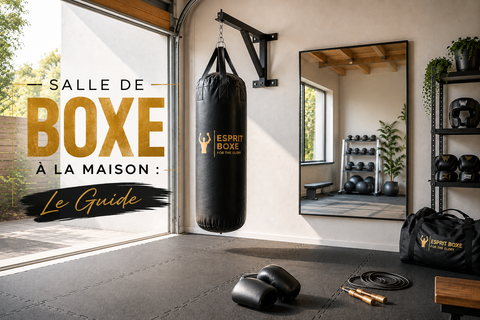
Before the fixing comes the space. Our home boxing gym guide sets out the floor area for each setup, how to work out ceiling height from bag length, the mat thickness each type of work calls for and how noise behaves in a shared building.