

The 6 Punches in Boxing: Jab, Cross, Hook and Uppercut
of reading
In short: boxing rests on four basic punches — jab, cross, hook and uppercut — which become six numbered punches, 1 to 6, once you separate lead hand from rear hand. The rulebook allows only the knuckle part of the glove, above the belt, on the front or side of the head and body. This guide covers each punch, the core combinations, the gear that develops them and the punches that are fouls.
Lewiston, Maine, 25 May 1965. Muhammad Ali defends the heavyweight title against Sonny Liston. In the first round Liston goes down to a right hand so short that part of the crowd insists it never landed. The press names it the phantom punch, and sixty years on the argument is still running. What that punch says about boxing fits in one sentence: power does not come from how far the arm travels, it comes from body rotation and timing. That is the common thread through every punch below.
Whether you are starting at a club or working alone on your punching bag, the arsenal is short: four basic movements, six punches once you separate the lead hand from the rear. Everything else — overhand, swing, body shots — is a variation on those four paths.
Stance and footing: where every punch starts
No punch makes sense without the starting position. In boxing the punching hand is named by its place in the stance, not by left or right: we say lead hand and rear hand. That is the vocabulary that lets an orthodox and a southpaw follow the same instruction.
| Stance | Lead foot | Lead hand | Rear hand |
|---|---|---|---|
| Orthodox (right-handed) | Left foot | Left — jab, lead hook | Right — cross, rear hook |
| Southpaw (left-handed) | Right foot | Right — jab, lead hook | Left — cross, rear hook |
Three markers hold in both stances: feet roughly shoulder width apart, weight forward on the balls of the feet, elbows tucked along the ribs and hands at cheekbone height. Every punch leaves that position and returns to it. The return matters as much as the delivery: an arm left extended after impact leaves the line open.
The detail that counts: power is built from the floor up to the fist. Foot pivots, hip turns, shoulder follows, fist arrives last. A punch thrown with the arm alone uses the shoulder; a punch thrown through the full chain uses the whole body. That is why footwork and skipping rope work comes before bag work in every gym warm-up.
The jab — punch no. 1
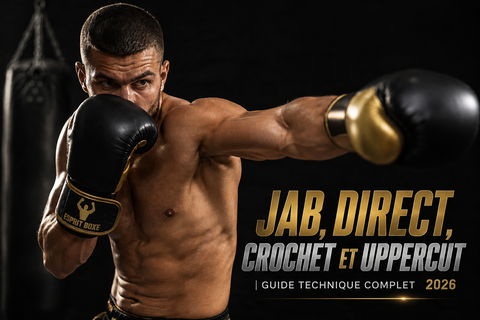
The jab is the straight punch from the lead hand. Straight line, shoulder rising to shield the chin through the extension, fist rotating so the knuckles land square, immediate return to guard. It is the most thrown punch in a fight, and it rarely ends one.
Its four real jobs:
- Measure the distance — a jab that lands with the tip of the glove tells you the cross will reach.
- Open the guard — it occupies the opponent's hands while the rear hand loads.
- Score — judges count clean punches, not only heavy ones.
- Hold range — a steady jab keeps an opponent from stepping in.
Variations worth drilling from the first sessions: the step jab (jab with a step forward), the jab to the body (bend the knees and drop the torso, never the head alone) and the double jab (two in a row, the second one heavier).
The cross — punch no. 2
The rear-hand straight. The rear foot pivots inward, the heel lifts, the hip turns, the rear shoulder drives forward and the fist takes the shortest line. The lead hand stays high throughout.
The cross travels the greatest distance and moves the most body mass. It is also the punch that dropped Liston in 1965. It is almost always thrown behind a jab: the 1-2 is the first combination taught in every gym on earth.
The hooks — punches no. 3 and no. 4
The hook is a circular punch at short and mid range. The elbow stays bent at roughly 90°, the foot pivot and torso rotation supply the power, and the fist arrives from the side onto a target a frontal guard does not cover: the temple, the jaw, the flanks.
The lead hook (no. 3) comes off the lead hand with a pivot of the lead foot. The rear hook (no. 4) comes off the rear hand with a pivot of the rear foot; it is rarer in a fight because it costs an extra beat.
The liver shot deserves its own line. Landed under the floating ribs on the opponent's right side, it hits the hepatic zone and produces pain that cannot be overridden by will. It explains a share of the stoppages that come from a fighter turning away rather than from a clean knockout.
The uppercuts — punches no. 5 and no. 6
The uppercut goes up. Elbow pointing down, fist starting around hip height and rising, palm turned inward, towards the chin or the solar plexus. The legs supply the drive: it is a knee extension as much as an arm movement.
This is the short-range punch. It travels between the two gloves of a closed guard, exactly where the jab and the cross run into the arms. The lead uppercut (no. 5) is fast and used as an opener; the rear uppercut (no. 6) is heavier and often arrives at the end of a sequence, when the opponent drops their torso.
Worth knowing: uppercuts and body hooks are hard to drill on a plain cylindrical bag, whose shape offers no upward angle. Anatomical-profile bags and focus mitts held by a partner give the right receiving surface for both paths.
Overhand, swing, body shots: the variations
Beyond the four basics, three paths turn up regularly in the ring:
- The overhand — a rear-hand punch on a semi-circular downward path, designed to travel over the opponent's lead arm or jab and reach the head. It is a counter-puncher's weapon, used to surprise or to launch a sequence.
- The swing — a wide lateral punch, broader than a hook. It gains reach at the cost of cover while the arm travels.
- Body versions — every punch on the list exists as a body shot. Dropping with the legs, torso angled but chin protected, lets you throw the same movement to the liver, the spleen or the solar plexus.
Reference table: the six numbered punches
The numbering is the working language of the gym. A coach calls « one-two-three » and the sequence starts with nothing else said. The most widespread system in boxing runs like this:
| No. | Punch | Hand | Path | Main target | Range |
|---|---|---|---|---|---|
| 1 | Jab | Lead | Straight | Face, body | Long |
| 2 | Cross | Rear | Straight | Chin, solar plexus | Long |
| 3 | Lead hook | Lead | Circular | Temple, jaw, liver | Short to mid |
| 4 | Rear hook | Rear | Circular | Temple, jaw, flank | Short to mid |
| 5 | Lead uppercut | Lead | Rising | Chin, solar plexus | Short |
| 6 | Rear uppercut | Rear | Rising | Chin, solar plexus | Short |
Some gyms add numbers for body versions (3b for a lead hook to the liver, for instance) or shift the uppercut numbering. Ask your gym for its convention in the first session: it is local, and the list above is the most common one.
The core combinations
A single punch is seen coming. Boxing is played in sequences of two to four, alternating lead and rear hand so the body rotation carries naturally from one to the next.
| Sequence | Punches | What it builds |
|---|---|---|
| 1-2 | Jab, cross | The fundamental combination: the jab opens, the cross finishes |
| 1-1-2 | Double jab, cross | Managing range before loading the rear hand |
| 1-2-3 | Jab, cross, lead hook | Moving from the straight line to the lateral angle |
| 2-3-2 | Cross, lead hook, cross | Continuous rotation, entry into mid range |
| 1-6-3 | Jab, rear uppercut, lead hook | Lifting the guard, then striking from the side |
| 5-2 | Lead uppercut, cross | Close-range work, exit on the straight line |
To put them into timed rounds, our punching bag exercise guide sets out round formats by level, and the 8-week home programme builds them into a full progression.
Which gear develops which punch
Every tool in the gym builds one specific quality. The table links the punches to the equipment that moves them forward fastest.
| Equipment | Punches trained | Quality developed |
|---|---|---|
| Punching bag | Cross, hook, body shots | Power, punching endurance, weight placement |
| Focus mitts | All six, in sequences | Accuracy, timing, reacting to a partner |
| Double end bag | Jab, repeated short punches | Rhythm, shoulder discipline, coordination |
| Speed bag | Jab, cross, counters | Timing on a moving target, return to guard |
| Reflex ball | Jab, short punches | Hand speed, head movement |
| Training sticks | Counters after a slip | Reading paths, reaction |
| Electronic machine | Prescribed sequences | Speed on a dictated sequence, measurable progress |
On personal kit, three things decide the quality of the punch: boxing gloves at the right weight, hand wraps that hold the metacarpals together, and a mouthguard as soon as you face an opponent. The glove size guide in oz gives the weight for your body weight, and the hand wrapping tutorial shows the placement that protects the impact zone.
Illegal punches in boxing
The list of legal punches follows from a rule about surface before it is a rule about zone. The British Boxing Board of Control defines a scoring blow as a direct clean hit with the knuckle part of the glove, to the front or side of the head or body above the belt — the belt being an imaginary line drawn across the body from the top of the hip bones. The inside of the glove, the heel or back of the hand, the wrist and the forearm are not legal striking surfaces.
On top of that come the zone and situation fouls, consistent across the BBBofC rules and the state commissions in the United States:
- Hitting below the belt, on the back, on the kidneys or on the back of the head or neck — the rabbit punch.
- Hitting with the open glove, the inside or side of the glove, the wrist, the elbow, the shoulder, the head or the knee. Backhand blows and the pivot blow are named fouls.
- Hitting an opponent who is down or getting up, or hitting on the break or after the bell.
- Holding and hitting, holding with one hand and hitting with the other, wrestling, or roughing at the ropes.
Penalties run from a verbal caution to a point deduction, then to disqualification for a repeated or serious foul.
What that changes in training: since only the knuckle face is a legal surface, that is the surface to learn to present from the very first bag session. A punch landed flat or on the side of the fist falls outside the rules and loads joints that are not built to absorb it. Close the fist completely before impact and keep the wrist in line with the forearm.
The gear that trains each punch:
Frequently asked questions
What are the 4 basic punches in boxing?
The jab, the cross, the hook and the uppercut. Since each can be thrown with the lead or the rear hand, you get six numbered punches, 1 to 6: 1 jab, 2 cross, 3 lead hook, 4 rear hook, 5 lead uppercut, 6 rear uppercut. Every other punch in boxing is a variation on those four paths.
What is the difference between a jab and a cross?
Both are straight punches; the hand is what changes. The jab comes off the lead hand (the left in an orthodox stance), it is fast, short in travel, and it measures and opens. The cross comes off the rear hand, travels further and uses the full hip rotation: it is the heavy half of the pair. In French the jab is officially named the « direct du bras avant » — the lead-arm straight.
What is the most powerful punch in boxing?
The cross and the rear hook engage the most body mass, because they start on the rear side and get the full rotation of foot, hip and shoulder. In practice the punch that ends a fight is rarely the hardest in absolute terms: it is the one that arrives at the right moment on an open guard. The liver shot is the most common example.
What do the numbers 1-2-3 mean in boxing?
It is the shorthand coaches use to call a sequence without describing it. 1-2 means jab then cross; 1-2-3 adds a lead hook. The most widespread convention runs 1 to 6 in the order jab, cross, lead hook, rear hook, lead uppercut, rear uppercut. Some gyms add their own numbers for body shots, so check the local convention in your first session.
What punches are illegal in boxing?
Punches below the belt, on the back, on the kidneys and on the back of the head or neck, plus any punch on an opponent who is down or getting up. The BBBofC rules also set the legal surface: the blow must land with the knuckle part of the glove. Open glove, the inside or side of the glove, the wrist, the elbow, the head and the knee are all excluded, as are backhand blows, the pivot blow, and holding while hitting.
Can you learn boxing punches at home?
The paths and the footing can be learned alone, in front of a mirror and then on the bag. Three things need outside feedback: guard height once you are tired, wrist alignment at impact, and real distance against a moving opponent. Even a short block of gym sessions corrects those three far faster than solo practice. Home work then carries the volume and the conditioning.