

Home boxing gym: space, ceiling height, flooring and budget
of reading
In short: a working home boxing corner fits in 4 m² / 43 sq ft for shadow work and rope, 6 m² / 65 sq ft as soon as a bag hangs, 8 m² / 86 sq ft with a free standing stand. Ceiling height is an addition: bag length + 20 to 35 cm / 8 to 14 in of hanging hardware + 20 to 40 cm / 8 to 16 in of floor clearance. Mat thickness follows the work you do on it, noise is solved before you buy, and a full first kit starts under €100.
The Kronk Gym in Detroit was never a facility: it was the basement of a municipal recreation centre, a low, overheated room where Emanuel Steward pushed the temperature past 32 °C / 90 °F. In March 1980 Hilmer Kenty took the world lightweight title out of it, the first of more than thirty world champions to come from that basement, Thomas Hearns among them. The lesson applies to your garage: the room does not make the gym, the layout does.
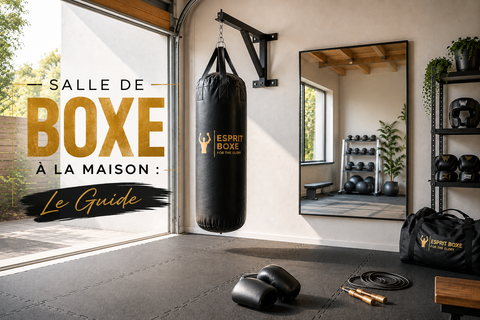
Four things decide whether your corner gets used daily or abandoned after a month: floor area, ceiling height, flooring, and the noise it sends through the building. This guide covers all four with numbers, then gives the buying order and three real budgets. For the fixing itself — anchors, joists, wall build-ups — the complete guide to hanging a bag takes over.
How much floor space a home boxing corner needs
The most asked question before buying, and the one that usually gets a vague answer. It is arithmetic. A heavy bag measures 36 to 60 cm / 14 to 24 in across. Around it you need one step back and one step to the side, roughly 1 m / 3 ft 3 in on every face, so that you box moving rather than planted. That gives a square of 2.4 to 2.6 m / 8 to 8 ft 6 in.
| Setup | Floor area | What it allows |
|---|---|---|
| No fixed equipment | 4 m² / 43 sq ft (2 × 2 m / 6 ft 7 in) | Shadow boxing, skipping, core work, reflex ball, bands |
| Bag on ceiling or wall bracket | 6 m² / 65 sq ft (2.5 × 2.5 m / 8 ft 2 in) | The bag plus a step back and a step sideways all around |
| Free standing bag stand | 8 m² / 86 sq ft | The stand footprint — 143 × 126 cm / 56 × 50 in on a 150 kg / 331 lb model — plus the working zone |
| Full corner | 12 m² / 129 sq ft | Bag, matted floor, machine or timer, storage, mirror |
Two practical markers. First, measure the area clear of furniture, not the room. A 15 m² / 161 sq ft garage with a car and a workbench in it offers 7 m² / 75 sq ft of real space. Second, the skipping rope asks for height more than area, but it still wants 1 m / 3 ft 3 in of side clearance or the rope catches the wall on every turn.
The detail that matters: a free standing bag stand is not pushed against a wall. Its rear upright is angled to take the push of the bag, and the bag swings backwards on every impact. Leave 40 cm / 16 in between the stand and the wall so the swing can happen.
Ceiling height by bag length
The height you need is a sum, not a single figure. Three elements stack:
- The bag length, from 60 cm / 24 in on a short model to 200 cm / 79 in on a banana bag.
- The hanging hardware — chains, swivel, carabiner: 20 to 35 cm / 8 to 14 in depending on the kit.
- The floor clearance, 20 to 40 cm / 8 to 16 in, so the bottom of the bag stays free to turn.
Add the three and you get the anchor height. The table applies the calculation to the lengths actually stocked, using 30 cm / 12 in of hardware and 30 cm / 12 in of clearance.
| Bag length | Anchor height needed | Typical use |
|---|---|---|
| 60 to 80 cm / 24 to 31 in | 1.20 to 1.40 m / 3 ft 11 in to 4 ft 7 in | Kids, hand work, tight spaces |
| 100 to 120 cm / 39 to 47 in | 1.60 to 1.80 m / 5 ft 3 in to 5 ft 11 in | Boxing at home, the most common format |
| 150 cm / 59 in | 2.10 m / 6 ft 11 in | Kickboxing, low kicks |
| 180 cm / 71 in | 2.40 m / 7 ft 10 in | Muay Thai, knees, leg kicks |
| 200 cm / 79 in | 2.60 m / 8 ft 6 in | Ground work on the bag, clinch, garage or high ceiling |
Measure your ceiling before you pick a length, not the other way round: it is the constraint that will not move. If the ceiling calls for 120 cm / 47 in when you wanted 180 cm / 71 in, the guide to choosing a punching bag covers the formats that make up for it — heavier fill, wider diameter, or a speed bag for close range.
Rope clearance test: raise one arm over your head and add 20 cm / 8 in. If the ceiling is higher, the rope clears. If not, move the rope zone under an open stretch of ceiling, or take it outdoors.
Flooring that takes the footwork
Tile and bare concrete send everything back: the shock travels up through ankles and knees on every step, and straight through the slab to the floor below. Matting absorbs both. Thickness follows what you do on it, not how big the room is.
| Surface | Thickness | Format | Best for |
|---|---|---|---|
| EVA tiles 30 × 30 cm / 12 × 12 in | 10 mm / 0.4 in | Packs of 4, 8 or 16 tiles | Standing work: shadow, rope, bag. The format that fits a small zone |
| EVA tiles 100 × 100 cm / 39 × 39 in | 20, 25 or 30 mm / 0.8, 1 or 1.2 in | 1 m² / 11 sq ft per tile, density approx. 80 kg/m³ / 5 lb per cu ft | A whole garage or room, repeated footwork and loaded equipment |
| EVA puzzle tatami | 25 to 50 mm / 1 to 2 in | 1 m² / 11 sq ft per tile, 80 kg/m³ / 5 lb per cu ft, embossed surface | Ground work, falls, grappling, long core sessions |
| Vinyl tatami | 40, 50 or 60 mm / 1.6, 2 or 2.4 in | 200 × 100 cm / 79 × 39 in, density 180 or 230 kg/m³ / 11 or 14 lb per cu ft | Throws and high falls, club use |
40 mm / 1.6 in is the international standard tatami thickness, and 230 kg/m³ / 14 lb per cu ft the judo reference density. For a standing boxing corner those figures go beyond the need: a boxing step is a pivot, not a fall. The 10 mm / 0.4 in tiles do the job under a bag, and joint comfort comes more from footwear than from mat thickness.
Check before ordering: the large formats ship by minimum area — 20 m² / 215 sq ft for puzzle tatami and vinyl tatami, 40 m² / 430 sq ft for the 100 × 100 cm tiles. For a 6 to 9 m² / 65 to 97 sq ft zone at home, the 30 × 30 cm tile packs are the right unit. Past 20 m² / 215 sq ft, in a full garage or a club room, puzzle tatami becomes the best value per square metre. Thicknesses and densities are listed in the gym mats and wall padding collection.
A boxing rug laid on top marks the zone visually and rolls away in three seconds when the room goes back to normal use — the answer for living rooms and bedrooms, where the boxing corner shares the space.
Noise, neighbours and what actually reduces it
This is what decides whether a flat works, and the point equipment guides skip most often. A heavy bag makes two different noises, and they are not solved the same way.
| Noise | Where it comes from | What reduces it |
|---|---|---|
| Impact noise | The strike itself, carried into the structure by the anchor | Anchoring into a thick internal load-bearing wall rather than a partition, plus a spring or shock strap between anchor and bag |
| Structure-borne noise | Footwork, jumps, vibration through the slab | 20 mm / 0.8 in of matting or more under the working zone, soft shoes, rolled rather than stamped steps |
Three decisions that change everything in a shared building:
- Anchor into an internal load-bearing wall rather than the one you share with a neighbour. The same wall bracket is discreet or intrusive depending on which wall it goes into.
- Choose the free standing stand in a rental or where the partitions are light: no drilling, and the weighted base keeps the bag off the building structure.
- Spread sessions across wide time slots rather than half an hour every night at 10 pm. In France, article R. 1336-5 of the public health code turns on duration, repetition and intensity, with no decibel threshold needing to be measured — and most tenancy agreements and building rules elsewhere follow the same logic.
The quiet alternatives: a music boxing machine trains speed and combinations on soft targets with no suspended mass. The double end bag and the reflex ball also make very little impact noise, and they work timing and accuracy.
Wall, stand or ceiling: what your building allows
The choice follows the structure available, in this order: concrete ceiling, load-bearing wall, then free standing.
| Solution | What it requires | What it gives |
|---|---|---|
| Ceiling mount | Concrete slab or structural joist, drilling | Full 360° swing, no floor footprint |
| Wall bracket | Load-bearing wall required: concrete, solid block or solid brick, with concrete anchors | 40 to 120 cm / 16 to 47 in of reach depending on model, up to 150 kg / 331 lb, floor kept clear |
| Free standing stand | A flat surface and the floor footprint | No drilling, movable, suits rentals and light partitions |
A plasterboard partition takes a mirror, a wall sticker or a padded panel very well; the load of a bag goes into the building structure or onto a stand. Esprit Boxe wall brackets ship with their concrete anchors and carabiner, and the hanging kit completes an existing setup. Drilling, anchor choice and joist location are covered in the complete guide to hanging a bag.
The order to buy in
The classic mistake is starting with the bag. It is the visible piece, but it depends on more prior decisions than anything else. This order avoids buying twice.
- 1
Measure
Clear floor area, ceiling height, wall build-up. Those three numbers drive everything else and take ten minutes to record.
- 2
Hands first
boxing gloves at the right weight and hand wraps that hold the metacarpals. This is the purchase that sets how long every later session lasts; the oz sizing guide gives the oz weight for your bodyweight.
- 3
The floor
Before the bag, because it goes under the bag and it sets both footwork comfort and transmitted noise. A few tile packs cover the working zone.
- 4
The fixing, then the bag
Bracket, stand or ceiling anchor according to what the structure allows, rated above the weight of the bag you want. The bag comes next, at the length your anchor height permits.
- 5
The clock
A programmable round timer splits the session into rounds and rest without watching the time. It is the accessory that turns a free session into measurable training.
- 6
Speed
speed bag, double end bag or reflex ball, once bag work is established. All three take little room and train what the heavy bag does not.
To fill those sessions, the 8-week home programme gives a full progression, and the bag exercises by level set out the round formats.
Three real budgets
The figures below start from actual entry prices in the Esprit Boxe catalogue, excluding promotions. They give an order of magnitude, not a quote.
| Level | What it holds | Budget range |
|---|---|---|
| The no-drill corner | Gloves, wraps, skipping rope, reflex ball, a few packs of EVA tiles | From about €90 |
| The bag corner | The above plus a heavy bag (€24 to €429), a wall bracket (from €59) or a stand (from €229) and a hanging kit (from €14) | €250 to €600 |
| The dedicated room | Full flooring, stand or reinforced bracket, programmable timer, boxing machine, speed bag and double end bag, lighting and decor | €1,000 to €2,500 |
One honest note on wall padding: it ships in panels of 40 × 180 cm / 16 × 71 in, with a minimum of 15 panels. That is club or large garage equipment, not living room equipment. For a single wall at home, a hanging mat or a foam panel behind the striking zone does the same job.
Light, mirror and decor: what makes you come back
A functional corner and a corner you want to walk into are two different things. Three elements make the difference, and none of them is expensive.
- The mirror. It is not decoration: it gives the visual feedback that is missing when you train without a coach. Guard height, wrist alignment, return to position — everything a coach calls out is visible in a mirror. A 120 cm / 47 in floor-standing model is enough.
- The light. A single ceiling fitting casts the shadow of the bag across the working zone. Two side sources light it better. neon signs add an ambient source that marks the zone without glare.
- The wall. A wall sticker or a piece of boxing wall art turns a stretch of garage into a gym. It is also what separates a training corner from a storage room with a bag in it.
Then comes the personal kit that follows close behind: a mouthguard from the first day of sparring, and the boxing accessories that finish off the gym bag.
To equip your space:
Frequently asked questions
How much space do you need for a punching bag at home?
Allow 6 m² / 65 sq ft, a square of 2.5 × 2.5 m / 8 ft 2 in. The bag takes 36 to 60 cm / 14 to 24 in of diameter and you want about 1 m / 3 ft 3 in of clearance all round to step back and circle. With a free standing stand, add its footprint — 143 × 126 cm / 56 × 50 in on a 150 kg / 331 lb model — and 40 cm / 16 in between stand and wall for the swing, which brings the need to 8 m² / 86 sq ft.
What ceiling height do you need for a heavy bag?
Add the bag length, the hanging hardware (20 to 35 cm / 8 to 14 in of chains and swivel) and the floor clearance (20 to 40 cm / 8 to 16 in). A 120 cm / 47 in bag needs an anchor around 1.80 m / 5 ft 11 in, a 150 cm / 59 in bag around 2.10 m / 6 ft 11 in, a 180 cm / 71 in bag around 2.40 m / 7 ft 10 in. Measure the height you have before choosing the length: the ceiling sets the format.
Can you hang a heavy bag from a ceiling joist?
A structural joist or a concrete slab is the strongest anchor available in a home, and it gives the bag a full 360° swing with no floor footprint. Locate the joist itself rather than the boards under it, and fix into its centre line. Where no joist runs across the zone you have chosen, a wall bracket on a load-bearing wall or a weighted free standing stand gives the same freedom of movement.
Can you use a punching bag in an apartment?
Yes, on three conditions. Anchor into an internal load-bearing wall rather than a party wall, or pick a free standing stand that keeps the bag off the building structure. Lay at least 20 mm / 0.8 in of matting under the working zone to absorb footwork. And spread sessions across wide time slots: French law, article R. 1336-5 of the public health code, turns on duration, repetition and intensity rather than a measured decibel level, and building rules elsewhere generally work the same way.
What flooring should you put under a punching bag?
For standing work, EVA tiles of 10 mm / 0.4 in in 30 × 30 cm / 12 × 12 in format cover the useful zone and are bought by the pack. For a full room or garage, 100 × 100 cm / 39 × 39 in tiles in 20 to 30 mm / 0.8 to 1.2 in give the cushioning and insulation of a continuous surface. As soon as there is ground work, falls or long core sessions, puzzle tatami of 25 to 50 mm / 1 to 2 in at 80 kg/m³ / 5 lb per cu ft is the right level; 40 mm / 1.6 in is the international standard.
How much does a home boxing gym cost?
A no-drill corner — gloves, wraps, rope, reflex ball and a few tile packs — starts around €90. Adding a bag with its bracket or stand brings the whole to between €250 and €600 depending on format. A dedicated room with full flooring, a programmable round timer, a boxing machine, a speed bag and lighting sits between €1,000 and €2,500. The buying order matters as much as the amount: measure, kit the hands, lay the floor, then fix the bag.