

Boxing mouthguard: choosing it, moulding it, caring for it
of reading
In short: a boil-and-bite mouthguard is moulded in water at about 80 °C / 176 °F, for 30 to 90 seconds depending on the model, then set in ice water. The single guard covers the upper jaw and is enough for boxing; the double covers both jaws and earns its place as soon as there are knees or ground work. With fixed braces, a standard boil-and-bite is not the answer: that is a call for your orthodontist. And a botched fit is recoverable, EVA remoulds.
In 1890, a London dentist named Woolf Krause shaped a strip of gutta-percha over his boxing patients' incisors and called it a gum shield: until then fighters clenched wood, sponge, cotton or tape between their teeth. His son Philip, a dentist and amateur boxer himself, turned it into the first reusable version, which made its public debut in 1921 at the Ted "Kid" Lewis versus Jack Britton championship — Britton's corner promptly complained it gave Lewis an unfair advantage.
A hundred and thirty years on, the principle has not moved: a material that softens with heat and takes the imprint of your teeth. What changed is the material, EVA, and the fact that fitting now happens at home in five minutes. It still has to be done right: a mouthguard that shifts gets bitten down on all session, and ends up staying in the bag.
Single, double or fanged: which one to take
Three families cover almost every need. The choice follows the discipline, not the price.
| Model | What it covers | For which practice |
|---|---|---|
| Single | The upper jaw | Boxing, light sparring, group classes. The standard: the lower jaw stays free, so breathing and talking are unimpeded |
| Double | Both jaws, joined | MMA, Muay Thai, kickboxing: knees, elbows and ground work, where the lower jaw takes hits too |
| Fanged | The upper jaw, pattern moulded in | Same protection as a single, with two-tone fangs formed during manufacture rather than printed on |
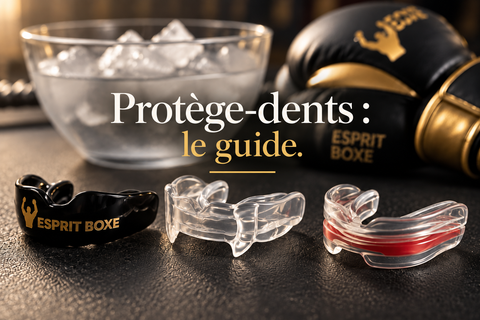
The single mouthguard comes in five colours, including a clear one that suits any club. The double mouthguard joins both trays: you talk less easily with it, but the lower jaw is covered. The fanged model offers ten colour combinations, with the pattern formed in the material, so it does not wash off.
The detail that matters: all these models measure 45 × 56 × 18 mm / 1.8 × 2.2 × 0.7 in in EVA. It is one universal blank, designed to be trimmed. If yours runs past the molars or rides high on the gum, cut it: that is expected, and covered below.
How to mould a mouthguard, step by step
The process is called boil and bite. Allow five minutes, and set everything out before heating the water: a pan, a bowl of ice water, a spoon or tongs, a mirror.
- 1
Try it cold
Put it in before heating anything. If it runs past the back molars, trim about 1 cm / 0.4 in from each end with scissors. If it presses on the front gum, take off a few millimetres. A guard that is too long triggers a gag reflex no amount of moulding will fix.
- 2
Heat the water to 80 °C / 176 °F
Bring the water to a simmer, then take the pan off the heat: at around 80 °C the EVA softens without distorting. At a full boil the material shrinks and loses thickness exactly where the bite needs it.
- 3
Immerse for 30 to 90 seconds
The time depends on the model and its thickness: start at 30 seconds, go to 90 for a double. The guard should turn soft and slightly translucent without slumping. Lift it out with the spoon and shake it once to clear the scalding water.
- 4
Seat it, then bite
Place it against the upper teeth with the incisors deep in the tray before closing. Bite down firmly and hold for 20 to 30 seconds. While you hold, suck as though through a straw and press the material onto teeth and gum with your tongue, fingers and cheeks: this step is the difference between a fit that holds and one that does not.
- 5
Set it in ice water
Take it out without distorting it and drop it in the ice water for 30 seconds. The cold locks the imprint. Then put it back in cold to check: it should hold on its own, jaw open, without you clenching.
- 6
Start again if needed
Thermoformable EVA remoulds. If it moves, put it back in hot water for slightly less time, since the material is already softened, and redo the bite. Two or three attempts will not damage it.
The four mistakes that ruin a fit
- Boiling water. Cause number one. At 100 °C / 212 °F the EVA shrinks and the useful thickness drops where it should stay.
- Biting without sucking. The bite alone prints the teeth but leaves a gap against the gum, and that gap is why the guard drops mid-session.
- Not trimming first. Once moulded, trimming shifts the imprint. Cutting is done cold, before the hot water.
- Skipping the ice water. The imprint sets as it cools. Left in open air it relaxes slightly and the hold goes.
Braces: the case apart
This is the question parents ask most, and it deserves a straight answer. A standard boil-and-bite takes the imprint of a set of teeth at one moment in time. Under fixed braces the teeth move at every adjustment: the imprint is wrong within weeks, and the brackets can cut the inside of the lips and cheeks on impact.
Orthodontic bodies recommend a thermoformable guard covering upper and lower teeth for contact sport. Two workable routes:
- Have an off-the-shelf guard adapted by your orthodontist, who shapes it to the arches — many will do it at a routine appointment.
- Use a model made for braces, in silicone, with an orthodontic channel that sits over the brackets and follows tooth movement without remoulding.
Worth knowing: the Esprit Boxe range is thermoformable EVA, designed for a settled set of teeth. If you wear fixed braces, speak to your orthodontist first: they know where your treatment stands. While you wait for an appointment, orthodontic wax protects the area that rubs during training.
Care: what decides how long it lasts
A mouthguard lives between a warm mouth and a closed box. That is a bacteria-friendly environment, and it is the care routine, not the brand, that decides how long it stays clean.
| When | What to do | Why |
|---|---|---|
| After every session | Rinse in cold water, brush with mild soap or toothpaste | Hot water softens EVA and distorts the imprint |
| Before storing | Dry fully in open air | A box closed on a damp guard keeps bacteria going |
| Storage | Vented case, never the bottom of the bag | Ventilation dries it, and the case protects it from being crushed |
| Weekly | Soak in cold water with a denture cleaning tablet | Handles odour without heat or alcohol |
| Never | Dishwasher, car in the sun, boiling water to clean it | Heat erases the fit in one go |
The same reflex applies to the rest of your kit: the glove care guide follows exactly the same drying logic.
When to replace it
A mouthguard is not replaced on a schedule, it is replaced on signals. Four are enough:
- It no longer holds on its own, jaw open, after a fresh moulding.
- The material is split, punctured or shows a tooth mark all the way through.
- The thickness over the molars is visibly crushed.
- An odour returns despite cleaning: the material has gone porous.
For a growing teenager, add a check at the start of each season: the dentition changes fast, and last year's imprint no longer matches.
Where it sits in your kit
The mouthguard protects what does not grow back. A broken tooth does not grow back, and the maths against the price of a crown is quickly done. So it comes in from the first day of contact work, before the more visible protection.
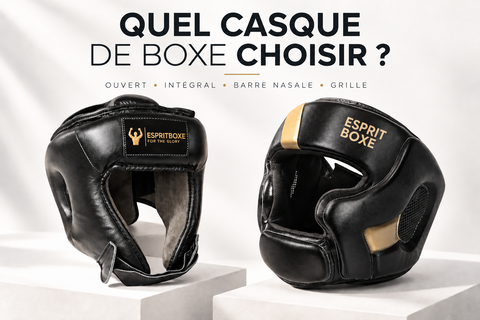
In order: boxing gloves at the right weight, hand wraps put on properly — the hand wrapping guide covers the technique — a mouthguard, then boxing headgear — our boxing headgear guide helps you choose between full face, face bar and cage — and protective gear once sparring becomes regular. The beginner equipment list pulls the whole thing together.
In the range, every Esprit Boxe model shares the same EVA and the same blank: what changes is the coverage, single or double, and the decoration. The Esprit Boxe model carries the brand in gold on black, and the country series runs in French colours, Belgium, Switzerland, Morocco, Algeria, Italy, Spain, Ivory Coast and Congo. All ship with their case.
To kit yourself out:
Frequently asked questions
What water temperature do you mould a mouthguard at?
Around 80 °C / 176 °F, meaning water brought to a simmer then taken off the heat. Immersion runs 30 to 90 seconds depending on thickness: start short on a single, go longer on a double. At a full boil the EVA shrinks and loses thickness where it matters. Ice water straight after locks the imprint.
Can you remould a mouthguard that came out wrong?
Yes, thermoformable EVA remoulds several times. Put it back in hot water for slightly less time, since the material is already softened, then redo the bite while sucking. Two or three goes will not harm it. Trimming, on the other hand, is always done before the first mould: cutting afterwards shifts the imprint.
Single or double: what is the real difference?
The single covers the upper jaw and leaves the mouth free to breathe and talk: it is the standard for boxing and light sparring. The double joins both trays and covers the lower jaw as well, which matches the disciplines where knees, elbows and ground work expose the bottom of the face: MMA, Muay Thai, kickboxing.
What if you wear braces?
A standard boil-and-bite moulds to a settled set of teeth, and teeth move at every brace adjustment. Two solutions: have an off-the-shelf guard adapted by your orthodontist at a routine appointment, or use a silicone model with an orthodontic channel, designed to sit over the brackets without remoulding. Either way, a guard covering upper and lower teeth is the recommendation for contact sport.
How do you clean a mouthguard without damaging it?
Rinse in cold water after every session, brush with mild soap or toothpaste, dry fully in open air, then store it in a vented case. Hot water is out for cleaning: it softens the EVA and erases the imprint. Once a week, a soak in cold water with a denture tablet deals with odour.
Why do boxing mouthguards so often have fangs or flags on them?
Because it shows head-on during a fight, unlike the rest of the kit. Headgear hides the face and wraps sit under the gloves, but the mouthguard shows every time the mouth opens. Hence the fang patterns and the national colour series that fighters use as a visual signature. On good models the pattern is formed in the material during manufacture, so it does not wash off.