

How to choose boxing headgear: open face, full face, face bar or cage
of reading
In short: boxing headgear first protects against cuts, bruising and head clashes, and it clearly reduces the acceleration your head takes from a punch — without removing the risk of concussion. For a beginner starting to spar, full face headgear with cheek and chin protection is the reference choice; a face bar closes off the line to the nose, a cage covers the whole face, open face headgear gives the widest field of vision. Size is taken with a tape measure about 2 cm / 0.8 in above the eyebrows: S around 53–55 cm / 20.9–21.7 in, M 55–58 cm / 21.7–22.8 in, L 58–61 cm / 22.8–24 in, XL above that.
At Rio 2016, male Olympic boxers stepped into the ring without headgear for the first time since Los Angeles 1984, following an AIBA decision taken in 2013. Women kept it, and it was still mandatory for every female boxer at the Paris 2024 Games.
That split fuels a common myth: if the best amateurs box without headgear, headgear must be useless. The reality is more precise, and it changes how you should choose yours. This guide covers what headgear actually protects, with lab figures, why Olympic men dropped it, the four types of headgear and who each one suits, how to measure your head to the centimetre, the 30-second fit test that saves you a return, and the care routine that decides how long it lasts.
What boxing headgear really does
Headgear has three jobs, in this order of importance day to day.
Preventing cuts and bruising. The brow, the cheekbone and the forehead are the areas that open up under a glove or a clash of heads. The padding spreads the pressure over a wider surface and keeps bone edges away from the skin.
Absorbing part of the impact. In 2015 the British Journal of Sports Medicine published tests by Andrew McIntosh and Declan Patton: a gloved fist driven by an impactor into an instrumented Hybrid III head, with and without AIBA-approved headgear. At 6.85 m/s, the angular acceleration of the head — the one that rotates the brain inside the skull — was almost halved by the headgear. Frontal punches at 45° and jaw shots at 60° were also damped.
Taking head clashes. In sparring, clashes of heads are among the most common accidents. Headgear turns a forehead-on-forehead collision into contact between two layers of foam.
What headgear does not do: it does not remove the risk of concussion. The brain can still move inside the skull, headgear or not. Your first protection remains defence — hands up, chin down, head movement — and sparring intensity, which you set with your partner and your coach.
Why Olympic boxers no longer wear headgear
AIBA relied on a study run from 2009 to 2013: bouts stopped for repeated blows to the head fell by 43 % among boxers fighting without headgear compared with those wearing it. Several explanations are put forward. Without headgear the head is a smaller target, the boxer sees punches coming from the sides more easily, and adopts a more defensive style. A coach and a doctor interviewed by the French boxing federation just over a year after the change reported the same thing: more slipping, far fewer head clashes.
The trade-off is well known: more facial cuts and broken noses. And the data came from three-round bouts between elite boxers, not from sparring repeated every week. Because the study only covered men, women kept their headgear. In training, where the punches you absorb add up session after session over a season, the competition reasoning does not carry over: headgear keeps all its value.
Is headgear mandatory in amateur boxing?
It depends on your federation, so check its current rulebook before you compete. At the Olympics, headgear is worn only in women's bouts. In France, for example, the national federation's amateur rules exempt senior men boxing 3 × 3 minutes, unless they face a junior; headgear is mandatory in competition for every other age category and for all female boxers.
In training, your gym sets the rule: ask before your first sparring session. Some gyms lend headgear to beginners, but loan headgear passes from one boxer to the next: owning your own is one of the first purchases after gloves, hand wraps and a mouthguard.
Open face, full face, face bar or cage: which headgear to choose
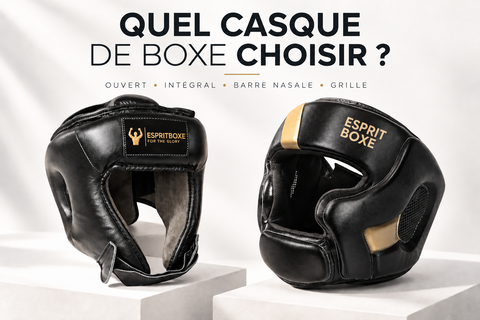
Four types cover every need. The more the headgear covers, the more it protects the face; the more open it is, the wider your field of vision. Choose on use.
| Type | What it protects | Field of vision | Best for |
|---|---|---|---|
| Open face | Forehead, skull, temples, ears, sometimes cheekbones | The widest | Technical sparring, experienced boxers, amateur competition |
| Full face with cheek protection | Skull, ears, cheekbones, jaw and chin | Wide | Beginners, regular gym sparring: the standard |
| Face bar | Everything a full face covers, plus a padded bar across the nose | Clear above the bar | Hard sparring, fight camp, returning after a broken nose |
| Cage | The whole face, nose and teeth included | Through the cage | Kids, first contact sparring, anyone keen to protect the face |
Open face headgear
It covers the top of the head and leaves the face clear: you see everything, including hooks coming in from the side. It is the cut closest to competition headgear. The genuine leather open face headgear also covers the cheekbones, with a suede lining. For long sessions or hot gyms, the vented headgear has a shell made entirely of 3D mesh, cheeks and ears covered, chin free.
Full face headgear with cheek and chin protection
This is the answer to "what headgear should a beginner buy". It wraps the cheeks and the jaw, where most poorly controlled punches between beginners land, while keeping the eyes clear. The genuine leather full face headgear is filled with triple-density foam and reinforced over the ears. For a head circumference above 61 cm / 24 in, the XL headgear adds a fourth size.
Face bar headgear
A padded bar runs across the opening at nose level: straight punches land on foam rather than on the bridge of the nose. Your eyes adapt within a few sessions to reading body shots over the bar. The genuine leather face bar headgear is the choice for heavy sparring blocks before a fight, and for boxers coming back from a fracture.
Cage headgear
The cage closes off the entire front of the face: nose, mouth and teeth are protected. It is the reassuring option for a first taste of sparring, and the one many parents pick for a child. The white and pink headgear comes on the same listing as an open version or with a full face cage, in kids' and adult sizes.
Face bar or cheek protection? If you are starting out and mostly spar light, full face headgear with cheek protection is enough and keeps your full vision. If your nose has already taken damage, or you are entering a block of hard sparring, the face bar is the right protection.
Boxing headgear size chart: measuring your head
Headgear size is chosen from head circumference, not clothing size.
- 1
Use a soft tape measure
A tailor's tape. Failing that, a piece of string you then measure flat against a ruler.
- 2
Place it 2 cm / 0.8 in above the eyebrows
The tape runs above the ears and around the widest point at the back of the skull, perfectly level.
- 3
Read it without pulling
The tape should touch without flattening your hair. Measure twice and keep the larger figure.
- 4
Check the model's own chart
Each headgear has its own size conversions, shown on its product page.
| Head circumference | Usual adult size | Profile |
|---|---|---|
| 53–55 cm / 20.9–21.7 in | S | Teenagers, slim builds, many women |
| 55–58 cm / 21.7–22.8 in | M | The most common adult size |
| 58–61 cm / 22.8–24 in | L | Larger build |
| Over 61 cm / 24 in | XL | Large head |
These markers apply to most adult headgear. Headgear designed for children has its own scale: the kids' headgear starts below 47 cm / 18.5 in in S, covers 47–53 cm / 18.5–20.9 in in M, roughly ages 7 to 15, and goes up to 62 cm / 24.4 in in L.
The 30-second fit test
With the headgear fastened, run three checks. Shake your head side to side, then forwards and back: the headgear follows with no lag. Push the front of the headgear upwards with your palm: it should not uncover the top of your forehead. Pull it downwards: it should not slide over your eyes. Headgear that twists during an exchange blocks your view at the worst moment — it is the fault that matters most. Between two sizes, take the snugger one: the foam settles with use and the headgear moulds to your head.
Leather, PU, microfibre and foam: what makes the difference
The outer shell. Genuine leather breathes and softens with use. PU leather is light, wipes clean with a sponge and suits recreational training or a child who is growing fast. Microfibre combines a leather-like feel with good resistance to moisture.
The padding. This is what works on every impact. Single-layer foam equips training and light sparring headgear. High-density foam takes more without flattening. Triple-density foam stacks three layers of different densities, designed for the heavier punches of regular sparring.
The closure. A rear hook-and-loop strap adjusts in two seconds, even between rounds. An extra strap over the crown adjusts the depth of the headgear. Rear lacing, found on the Winning FG-2900 headgear, follows the exact shape of the back of the head and is best adjusted with a partner's help.
Kids' and women's boxing headgear
For a child, three things come first: a size that matches the measured head circumference, not a size "to grow into" that floats and twists; cheek and jaw protection; and a face cage for the first sparring sessions if the child or the parents want one.
For women, head circumference is again the deciding factor, often S or M. In amateur boxing, women wear headgear in competition, Olympics included: pick a model you forget you are wearing, with a crown strap that stops it sliding on tied-back hair.
By discipline: boxing, Muay Thai, kickboxing, MMA
In boxing, every punch lands above the belt and many target the head: full face with cheek protection and face bar headgear are the two most common choices for sparring. In Muay Thai and kickboxing, head kicks and knees add to the punches, hence the value of well-wrapped jaw protection. In MMA, groundwork and takedowns call for compact headgear that does not snag: the vented headgear, chin free, is designed for grappling and beginners' classes. To compare the disciplines themselves, see our guide boxing, Muay Thai, kickboxing or MMA.
Care and lifespan
Headgear soaks up a full session of sweat, right against your face. Three habits after every workout are enough:
- Take it out of your bag as soon as the session ends and open the straps so it dries in the open air, inside and out.
- Wipe the inside with a cloth dampened with water and a mild disinfectant, then let it dry.
- Dry it away from radiators and direct sunlight, which stiffen leather and tire the foam.
Replace your headgear when the foam stays dented after an impact instead of springing back, when it twists on your head even at its tightest setting, or when the lining tears enough to expose the foam. The same principles apply as for gloves: our guide to cleaning and caring for boxing gloves lists the products that respect leather.
Custom headgear for your gym
A gym equipping its boxers can have headgear made in its colours, with its logo, the boxer's name or initials. Custom boxing headgear is available in every type — open face, full face, face bar — in genuine leather, PU leather or microfibre, from a single piece to a batch of 20, sizes S to XXL.
Frequently asked questions
What is the best boxing headgear for beginners?
Full face headgear with cheek and chin protection. It covers the cheeks and jaw, where most poorly controlled punches between beginners land, while keeping the eyes clear. Choose it from your head circumference measured with a tape, with a rear hook-and-loop closure and ideally a crown strap so it does not twist.
Why don't Olympic boxers wear headgear?
Because AIBA removed headgear for senior men in 2013, after a study run from 2009 to 2013 found that stoppages for repeated blows to the head were 43 % less frequent without it. The rule has applied at the Olympics since Rio 2016, the first Games without men's headgear since 1984. As the study only covered men, women kept their headgear, still mandatory for them at Paris 2024.
How should boxing headgear fit?
Snug, with no lag. Measure your head about 2 cm / 0.8 in above the eyebrows; for adults, S is usually 53–55 cm / 20.9–21.7 in, M 55–58 cm / 21.7–22.8 in, L 58–61 cm / 22.8–24 in and XL above. Fastened, the headgear should follow every head movement, stay put when you push the front upwards and never slide over your eyes. Between two sizes, take the snugger one.
Does boxing headgear prevent concussions?
It reduces the impact reaching the head without removing the risk. In tests published in 2015 in the British Journal of Sports Medicine, approved headgear almost halved the head's angular acceleration under a gloved punch at 6.85 m/s. Its most visible job is preventing cuts and bruising. Defence and controlled sparring intensity remain the first protection.
Face bar or cheek protection headgear: which is better?
Cheek protection keeps your full field of vision and suits light sparring and most beginners. A face bar adds a padded bar across the nose so straight punches land on foam. It makes sense for hard sparring, fight camp or after a broken nose, and your eyes adapt to it within a few sessions.
Is headgear mandatory in amateur boxing?
It depends on the federation and the category. At the Olympics it is worn only in women's bouts. In France, senior men boxing 3 × 3 minutes are exempt unless facing a junior, and every other category must wear it in competition. In training, your gym's rules apply.